The most expensive decision in international SEO is usually made first, fastest, and by whoever set up the CMS. It is the only choice on an international audit that is genuinely hard to reverse, so it deserves an hour of thought before a single page is translated.
What Google’s documentation actually says
Google sets out four ways to structure a multi-regional site, with its own pros and cons for each. Here they are in Google’s words, from its guide to managing multi-regional and multilingual sites, last updated in December 2025:
| Structure | Google’s pros | Google’s cons |
|---|---|---|
Country-code domainexample.de | Clear geotargeting · Server location irrelevant · Easy separation of sites | Expensive (can have limited availability) · Requires more infrastructure · Strict ccTLD requirements (sometimes) · Can only target a single country |
Subdomainde.example.com | Easy to set up · Allows different server locations · Easy separation of sites | Users might not recognize geotargeting from the URL alone |
Subdirectoryexample.com/de/ | Easy to set up · Low maintenance (same host) | Users might not recognize geotargeting from the URL alone · Single server location · Separation of sites harder |
URL parametersexample.com?loc=de | None listed | Not recommended · URL-based segmentation difficult · Users might not recognize geotargeting from the URL alone |
Two things stand out. URL parameters are the only option Google explicitly does not recommend. And none of the trade-offs Google lists between subdomains and subdirectories is about ranking: they concern how clearly the URL signals a country, how much infrastructure you run, and how easily the sites can be separated.
What changed: there is no country setting any more
For years you could tell Search Console which country a subfolder or subdomain was aimed at. Google deprecated the International Targeting report in August 2022, explaining that country targeting in Search Console “was determined to have little value for the ecosystem.” Hreflang, it said, stays supported.
So the country signal now has to come from the site itself. Google lists what it uses: a country-code domain, hreflang, the server’s location, and other signals such as local addresses and phone numbers, local language and currency, and links from other local sites. It also lists what it does not use: it ignores locational meta tags such as geo.position, and it tells site owners not to use IP analysis to adapt their content.
The practical consequence: a country-code domain is the only structure that carries a country signal by itself. A subfolder or subdomain relies on hreflang and on-page signals to do that job — which they do perfectly well, when they are implemented correctly.
What the documentation leaves out
Google’s table is accurate and incomplete. It describes the structures. It does not describe the costs that decide which one a business can actually sustain.
Every new domain starts with no links
A new country domain has no referring domains on the day it launches. A subfolder on an established domain launches onto a link profile the business has spent years building. That difference appears in no comparison table, and it is the single biggest reason I recommend subfolders by default: the new market does not have to earn its authority from zero.
Everything multiplies
Five country domains means five domains to renew, five certificates, five Search Console properties, five analytics set-ups — and, the one that sinks budgets, five link-building programmes. Some registries add eligibility rules of their own, which is what Google’s “strict ccTLD requirements” refers to.
Subdomains usually mirror the org chart
When a site uses subdomains, the reason is rarely SEO. A different team, a different platform or a different agency runs that market, and a subdomain is the easiest way to let them. That can be a legitimate reason. It should be a conscious one.
Changing your mind is a migration
Moving from subdomains to subfolders later means redirecting every URL in every market, then absorbing the volatility that follows. That is why architecture comes first in my international SEO audit checklist — and why “it came with the CMS” is not an answer.
The decision, as I would make it
For most businesses selling into several markets, the answer is a subfolder. The exceptions are specific, and each one comes with a reason you can write down.
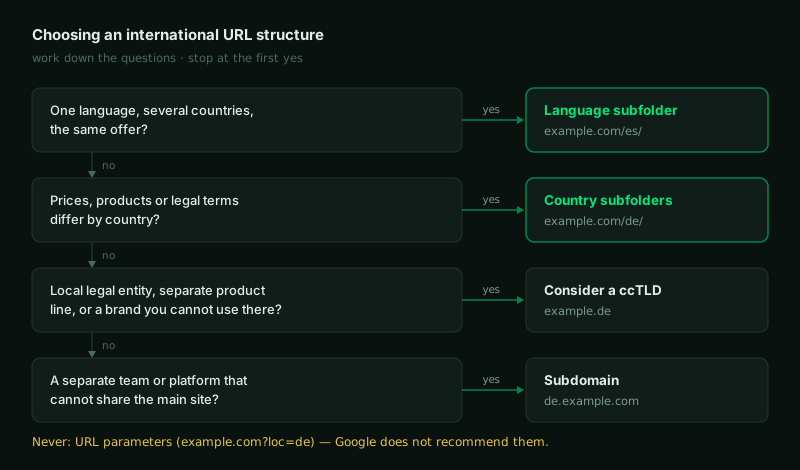
Same offer, one language, several countries → a language subfolder
A single
/es/section can serve Spain, Mexico, Colombia and Argentina at once. This site does exactly that: one Spanish section and no country sites.Prices, products or legal terms differ by country → country subfolders
/de/,/fr/,/es-mx/— each declaring language and country in hreflang, on the domain that already has the links.A local legal entity, a genuinely separate product line, or a brand you cannot use there → consider a country domain
Then budget for building that market’s authority from nothing. I set the bar in the same place in the note on entering the German market: a .de helps marginally with trust, and rarely justifies the cost on its own.
A separate team or platform that cannot share the main site → a subdomain
Accept the operational split knowingly, and implement hreflang across hosts as carefully as you would within one.
URL parameters → no
Google does not recommend them, and neither do I.
The mistakes I see most
- Three structures at once.
/de/on the main domain,example.franduk.example.com— each chosen by a different project, none by a strategy. - Folders named after countries, filled by language. A folder called
/uk/for British English breaks nothing by itself, but it invites the matching mistake in hreflang, whereukmeans Ukrainian. My hreflang generator flags exactly that. - Redirecting visitors by IP. Google advises against adapting content based on IP analysis. Offer a visible way to switch market instead, and let crawlers reach every version.
- Choosing country domains without funding them. The structure was chosen for the launch; the link building needed to make it work was never in the budget.
Sources
- Google Search Central, Managing multi-regional and multilingual sites, last updated 10 December 2025.
- Google Search Console Help, The International Targeting report is deprecated, retrieved 14 September 2026.