Every hreflang set leaves one question open: what should Google show someone whose language you do not serve? x-default is the answer you give in advance. It is optional and it is one line — and on most sites I audit it points somewhere nobody chose on purpose.
What x-default tells Google
An ordinary hreflang annotation says “this URL is for this language”, or “for this language in this country”. x-default is the one value that names no language at all. Google’s documentation says it is “used when no other language/region matches the user’s browser setting”, and recommends it for “specifying the fallback page for users whose language settings don’t match any of your site’s localized versions.”
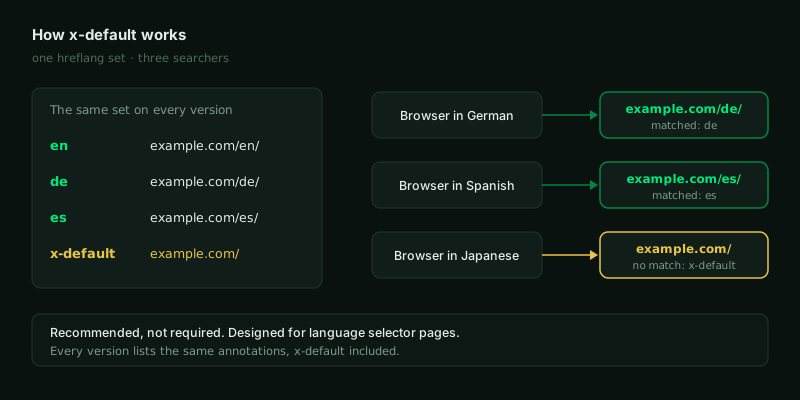
For a page in English, German and Spanish, a complete set looks like this:
<link rel="alternate" hreflang="en" href="https://example.com/en/">
<link rel="alternate" hreflang="de" href="https://example.com/de/">
<link rel="alternate" hreflang="es" href="https://example.com/es/">
<link rel="alternate" hreflang="x-default" href="https://example.com/">
Someone whose settings are German is matched to the German page. Someone whose settings are Japanese matches nothing, so Google can use the x-default page instead. When Google introduced the value in April 2013, its example was a site with versions for the UK, the US and Australia: the default page, it said, was the one its algorithms would “try to show French-speaking searchers worldwide or English-speaking searchers on google.ca.”
Two things x-default is not:
- It is not a language. You do not need to give the x-default page a language code, because, as Google puts it, “the language of the page is irrelevant.”
- It is not required. It is recommended. Without it Google still serves each version to the users it matches, and decides for itself what to show everyone else.
What it was designed for
Google is specific about this: “While you can use the x-default value for any page, it was designed for language selector pages and so it will work best with those.” The 2013 announcement covered a second case too — home pages that redirect visitors, or change their content, based on location or browser language. Such a page belongs to no single locale, so x-default is the honest label for it.
That second case needs a warning. Google’s documentation on locale-adaptive pages says Googlebot’s default IP addresses appear to be in the USA and that it sends requests without an Accept-Language header, so a page that adapts to the visitor may only ever show Google one of its versions. Its recommendation is separate URLs per locale, annotated with hreflang. Its multi-regional guidance goes further and advises against automatically redirecting users between language versions at all. x-default makes a redirecting home page easier to interpret; it does not make redirecting a good idea.
Where to point it
There are three sensible choices:
- A language or country selector. The design case, and the best choice when no single version suits most unmatched visitors.
- The version most unmatched visitors can read — usually English. The most common choice, and a reasonable one: the same URL can carry both
enandx-default, and Google’s John Mueller has confirmed that several hreflang values may point at one URL. - A genuinely international version, where one exists — an “international English” site for every country without its own.
Whichever you choose, the x-default URL has to be a page Google would happily index, and it has to be part of the set: every version of the page lists the same annotations, x-default included.
What international brands do with it
On 15 September 2026 I requested the home pages of 60 international brands, once each, using the same code that runs this site’s hreflang checker, and read the annotations in the HTML they returned. Two caveats first. Twenty-six could not be read at all — bot checks and access blocks, timeouts, an age gate — and because the requests came from Poland, several sites served their Polish home page. That left 34 readable home pages, 19 of them with hreflang in the HTML.
| What the home page declared | Pages |
|---|---|
| hreflang, with x-default pointing at the English version | 11 |
| hreflang, with x-default pointing at a global page or the root domain | 2 |
| hreflang, with no x-default at all | 6 |
Pointing x-default at English is the norm. Siemens, HubSpot, Dropbox, Wise, Duolingo and Red Bull all do it. The design case is rare. IKEA points x-default at its “Welcome to IKEA Global” page, which is precisely the selector Google describes, and Klarna at its root domain — which, requested from Poland, redirected to the Polish site: the redirecting home page from Google’s 2013 example. And large sets often have none. Apple’s home page declares 137 alternates and Airbnb’s 96, neither with an x-default. Nothing is broken there, since the value is optional, but both have left the unmatched-language decision to Google.
Mistakes I find in audits
- x-default on some versions and not others. Typically a template that adds it to one language only. Every version of a page should carry the same set.
- Two x-default values pointing at different URLs. They contradict each other, exactly as two
enannotations with different URLs would. - An x-default URL Google will not index. A page that returns 404, carries
noindex, or has since moved permanently to another address. - A relative or protocol-less URL. Google requires fully-qualified URLs for every hreflang value, x-default included.
One more is a judgement rather than an error. Google’s own example points a deep page’s x-default at the site’s home page, and that is allowed. But when a deep page has an English equivalent, sending unmatched visitors to that equivalent serves them better than dropping them on a home page and making them search again.
How I set it
My default: x-default points at the page’s English version on sites where English is the main language, and at a real language selector where no single language is. On this site, every English page that has a Spanish version carries both en and x-default on the same URL. Then I check the whole set rather than the home page, because a missing or broken x-default stays invisible until someone who speaks none of your languages arrives.
The hreflang checker reports a set with no x-default, more than one, or an x-default URL that fails or redirects. The hreflang generator lets you add it and checks the rest of the set.
Sources
- Google Search Central, Tell Google about localized versions of your page, last updated 22 December 2025.
- Pierre Far, Introducing “x-default hreflang” for international landing pages, Google Search Central Blog, 10 April 2013.
- Google Search Central, How Google crawls locale-adaptive pages and Managing multi-regional and multilingual sites, both last updated 10 December 2025.
- John Mueller on assigning several hreflang values to one URL, SMX Munich 2016 and Twitter, 2 March 2017, reported by searchVIU.
- Home pages of 60 international brands, requested once each from Poland on 15 September 2026 with this site’s hreflang inspector: 34 readable, 19 with hreflang in the HTML.
Questions
en and x-default. Eleven of the thirteen brand home pages with an x-default in my September 2026 check pointed it at English. A language selector is the case Google designed it for.