The most expensive keyword mistake in international SEO costs nothing to make. You take the keyword list that works at home, have it translated, and build the new market’s pages around the result. Every word is correct. They are just not the words people in that market type. Here is what that looks like in real search volumes, and the process I use instead.
One service, five markets
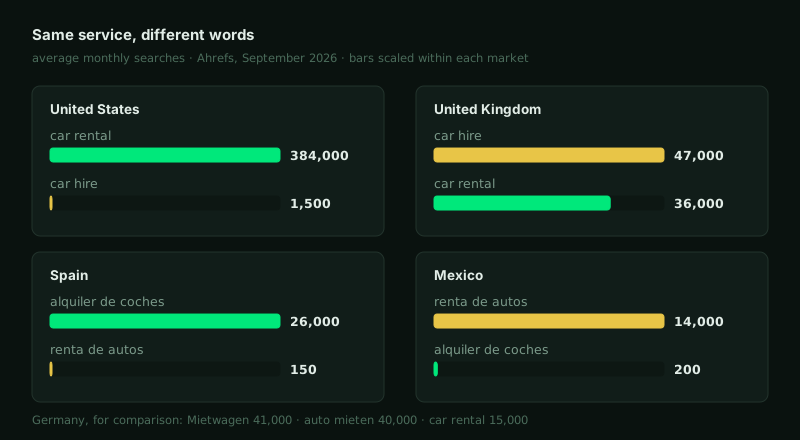
Take something every market buys: renting a car. These are the average monthly searches for the main ways of saying it, pulled from Ahrefs on 15 September 2026:
| Market | Top term | Other ways people search |
|---|---|---|
| United States | car rental 384,000 | rent a car 130,000 · rental car 87,000 · car hire 1,500 |
| United Kingdom | car hire 47,000 | car rental 36,000 · rent a car 35,000 · rental car 3,100 |
| Spain | alquiler de coches 26,000 | rent a car 14,000 · alquiler coches 7,500 · alquiler de autos 600 · renta de autos 150 |
| Mexico | renta de autos 14,000 | renta de carros 5,100 · rent a car 2,800 · renta de coches 1,000 · alquiler de coches 200 |
| Germany | Mietwagen 41,000 | auto mieten 40,000 · Autovermietung 19,000 · car rental 15,000 · rent a car 10,000 |
Three things in that table should change how you plan a new market:
- A shared language is not a shared vocabulary. Spain and Mexico both speak Spanish, and each market’s top term is almost unused in the other. “Alquiler de coches” gets 26,000 searches a month in Spain and 200 in Mexico; “renta de autos” gets 14,000 in Mexico and 150 in Spain.
- English is not one market either. “Car hire” is the UK’s biggest term and a rounding error in the US.
- The local language is not the only language. Germans search “car rental” 15,000 times a month and Spaniards type “rent a car” 14,000 times. Loanwords are part of the market, and a list built from translations drops them.
Now run the usual workflow on this. A brief written for “car rental” goes to a translator trained in Spain’s Spanish, who renders it, correctly, as “alquiler de coches” for the Mexican site. The page is fluent, accurate and aimed at 200 searches a month.
Why translated keyword lists fail
A translator’s job is to preserve meaning. Keyword research is about behaviour: which of several correct phrasings people actually use. That is shaped by things no dictionary records — local competitors and marketplaces, regional vocabulary, how the category is sold in that country. What a translator needs from you is covered in how to brief a translator so the page ranks. The research behind that brief is a separate job, and it has to be done in the market.
Translation breaks keyword research in two more ways:
- Grammar changes the query. German compounds collapse several English words into one, which has its own section in entering the German market, and inflected languages such as Polish spread a single search across several word forms.
- Intent shifts. The same phrase can be commercial in one country and informational in another, depending on what the local results page shows. You only find out by looking at it.
What the tools can and cannot compare
Keyword Planner
Google’s own tool reports average monthly searches for the locations and network you select. Two details matter internationally. The figure covers a keyword and its close variants, so small variations are pooled and you will not get a separate number for every form. And by default searches are counted “regardless of language”: in a country where people search in two languages, the number is for that string, whoever typed it. You also need a Google Ads account with billing details to use it, and very low-volume or sensitive keywords return nothing at all.
Google Trends
Good for comparing phrasings and seasonality within a market; misleading across markets. Trends divides every data point by the total searches in that place and time, then scales the result from 0 to 100 — so, in Google’s words, “different regions that show the same search interest for a term don’t always have the same total search volumes.” A score of 80 in Portugal and 80 in Brazil describe very different amounts of demand. Trends also drops low-volume terms, and it excludes the internal searches that AI Mode and AI Overviews make.
Third-party keyword databases
Ahrefs, Semrush and similar tools estimate volumes per country, and their country databases are what make a table like the one above possible. The estimates are least reliable exactly where international SEO needs them most: small markets and long-tail terms. Use them to rank terms against each other inside one market, not as exact counts.
And check which search engine you are researching
In most markets this is Google’s game. By StatCounter’s count for August 2026, Google held 94.8% of search in Spain, 91.8% in the UK, 89.4% in Poland, 88.5% in Germany, 88.4% in Mexico and 86.1% in the US. Not everywhere, though: Seznam still has 15.6% in the Czech Republic, and in South Korea Naver’s 43.7% sits almost level with Google’s 46.6%. Research for those markets has to include the local engine.
How I research keywords for a new market
Start from the market, not from your list
A native speaker who knows the category writes the seed list from scratch: what they would type, what local competitors call the service, what marketplaces and forums say. Only then compare it with the home-market list — looking for gaps, not translations.
Pull every variant’s volume in that country
Regional forms, loanwords, the English term, singular and plural. The winner is often not the term the brand uses internally.
Read the local results page for each head term
From the target country, in its language. Who ranks — brands, marketplaces, publishers — tells you the intent and the realistic competition better than any difficulty score. The local SERP checker opens them for every market at once.
Map terms to URLs, market by market
One primary term per page per market, recorded in a keyword-by-market matrix. Where two markets share a language, decide deliberately whether one page serves both, and declare the relationship with hreflang.
Prioritise by market value, not volume
A smaller term in a high-margin market can be worth more than a big one in a market you barely serve. Rank opportunities by what a customer is worth in each market, and re-check the matrix every year: vocabulary drifts, and competitors teach markets new words.
Research each market in its own words. Translation tells you what a word means; only local search data tells you whether anyone uses it.
This research also settles a structural question. If two markets that share a language search as differently as Spain and Mexico do above, one page will struggle to rank in both — which feeds straight into choosing between subfolders, subdomains and country domains. When it is skipped, the gap tends to surface a year later as a content parity problem.
Sources
- Ahrefs Keywords Explorer, average monthly search volume for the listed terms in the United States, the United Kingdom, Spain, Mexico and Germany, retrieved 15 September 2026.
- Google Ads Help, Use Keyword Planner and About Keyword Planner forecasts, retrieved 15 September 2026.
- Google Trends Help, FAQ about Google Trends data, retrieved 15 September 2026.
- StatCounter Global Stats, search engine market share by country, August 2026.