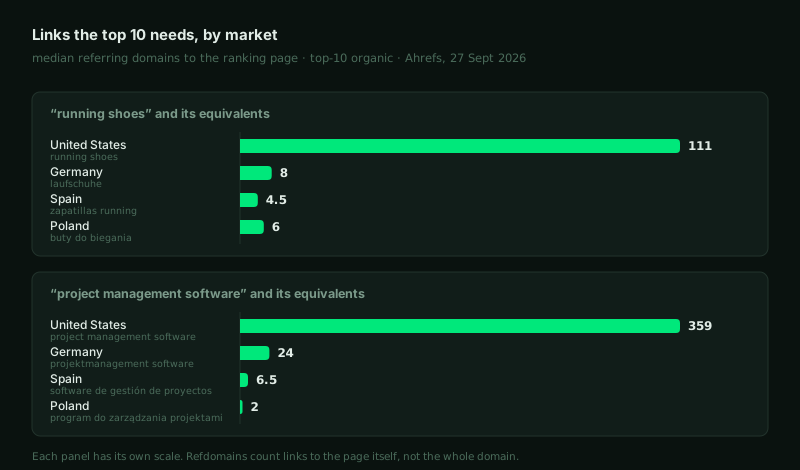
Search “running shoes” in the United States and the pages in the top ten have a median of 111 other sites linking to them. Search the same thing in Germany and the figure is 8; in Spain, 4.5; in Poland, 6. International link building starts from that gap: a link is worth a different amount in every market, and most budgets are split as though it were not.
What Google says local links do
Google lists the signals it uses to work out which country a page is for: country-code domains, hreflang, server location and “other signals”, which it spells out as “local addresses and phone numbers on the pages, the use of local language and currency, links from other local sites”. A link from a Spanish site to your Spanish page does two jobs at once — authority, and a hint about who the page is for. A link from a generic English blog to the same page does only the first, and does it weakly.
The same query in four markets
On 27 September 2026 I pulled the top ten organic results for two commercial queries and their local equivalents in the United States, Germany, Spain and Poland, using Ahrefs, and took the median number of referring domains pointing at each ranking page.
| Query | United States | Germany | Spain | Poland |
|---|---|---|---|---|
| Running shoes — median referring domains | 111 | 8 | 4.5 | 6 |
| Running shoes — median Domain Rating | 85 | 42 | 48.5 | 46 |
| Project management software — median referring domains | 359 | 24 | 6.5 | 2 |
| Project management software — median Domain Rating | 78 | 75.5 | 81.5 | 57 |
Two things stand out.
Page-level links collapse outside the US, even where the domains stay strong. For project management software the ranking domains in Spain are as strong as the American ones — Asana, Wrike, Zoho and Slack all rank with their Spanish pages — yet the median Spanish page has 6.5 referring domains against 359. The international domain carries the local page. For a brand that already has authority, the local page needs far fewer of its own links than the US equivalent would.
Small sites win in smaller markets. Running shoes in Poland has pages from sites rated 20 and 24 in the top ten with one and four referring domains. Germany’s top result for laufschuhe comes from a specialist shop rated 39 with two. The bar a local challenger has to clear is low, and it is set by local competitors rather than by Nike.
The caveats matter. Two queries are not a law, and referring domains are a correlate of ranking, not the cause of it. A third set, espresso machines, pointed the same way in the US and Germany, but in Spain and Poland the results were almost all product and marketplace pages with too little link data to count. Do this for your own queries before you set a budget: ten minutes per market with any link tool, or with the local SERP checker to see what ranks where.
Where local links actually come from
- Local press, pitched locally. A press release translated from English is still an English story. What earns coverage in Spain is a Spanish angle: local data, a local customer, a local price comparison. The same study cut by country gives you one story per market.
- Your own partners. Distributors, resellers, agencies and integration partners in each country often link to you already — to the
.comhome page. Asking them to point at the local page costs nothing and is usually the fastest win. - Associations, chambers and trade bodies. Membership directories in the local trade association or chamber of commerce are genuine, relevant and local by definition.
- Events and sponsorships that happen in the country. A local meetup page links to its sponsors; a global conference rarely helps a single market.
- Local directories people actually use. Not link directories — the review, comparison and industry listings that rank in that market. Check which ones show up for your queries.
What does not travel
Links pointed at the wrong page. A German link to your English home page helps the domain a little and the German page not at all. Point local links at local URLs.
English guest posts on “international” blogs. They carry none of the local signal, and the sites that sell them to every market are the ones Google has least reason to trust.
Bought links. Google’s spam policies list “buying or selling links for ranking purposes” as link spam, in every language. Paid placements are allowed when the link carries rel="sponsored" or rel="nofollow"; then they are advertising, and should be budgeted as such.
How to split a budget across markets
Measure each market’s bar
For five to ten commercial queries per market, note the referring domains of the pages ranking three to ten. That median is roughly what a page needs to compete.
Compare it with what you have
Your local page’s own referring domains, not your domain’s. The gap per market is the real brief.
Spend where the gap is small and the market is worth it
Closing a gap of five links in Spain can be worth more than adding fifty in the US, if Spain converts. The SEO forecast calculator helps put a number on it.
Fix the free links first
Partners, distributors and existing mentions that point at the wrong page or at nothing. Then earn the rest locally.
This is how link building works here: every target justified per market before outreach, and links pointed at the page that needs them.
Sources
- Google Search Central, Managing multi-regional and multilingual sites, last updated 10 December 2025: signals used for locale targeting.
- Google Search Central, Spam policies for Google web search: link spam.
- Ahrefs SERP overview, 27 September 2026: top-10 organic results for “running shoes”, “laufschuhe”, “zapatillas running”, “buty do biegania”, “project management software”, “projektmanagement software”, “software de gestión de proyectos” and “program do zarządzania projektami” in the US, Germany, Spain and Poland respectively. Medians over organic results with link data; SERP features excluded.
Questions
rel="sponsored" or nofollow — then they are advertising, not SEO.