Search for a treatment in Germany and about one result in eight comes from the company that makes it. In the United States it is one in fifty. The gap is not SEO skill. It is law: where a prescription medicine cannot be advertised to the public, the manufacturer’s search asset is a disease website that never names the drug.
The law behind the gap
In the European Union, Article 88(1) of Directive 2001/83/EC says Member States “shall prohibit the advertising to the general public of medicinal products” that are available on medical prescription only. Germany applies it in § 10(1) of the Heilmittelwerbegesetz: prescription-only medicines may be advertised only to doctors, dentists, vets, pharmacists and licensed traders in them.
The Directive leaves one door open. Article 86(2) lists what does not count as advertising, including “statements relating to human health or diseases, provided there is no reference, even indirect, to medicinal products.” That sentence is why a manufacturer can publish a site about psoriasis, migraine or asthma, and why those sites do not mention the product.
The United States regulates instead of prohibiting. FDA’s rule requires prescription-drug advertisements to carry “a true statement of information in brief summary” on side effects, contraindications and effectiveness (21 CFR 202.1(e)(1)), and a branded consumer site is possible.
This is not legal advice, and what is compliant in each market is for regulatory affairs and legal to decide. What an SEO can do is read what the results pages show.
What the results pages show
On 3 October 2026 I took the top ten organic results for the same eight treatment queries in the United States, Germany and Spain through Ahrefs — type 2 diabetes, psoriasis, migraine, eczema, high blood pressure, asthma, allergic rhinitis and osteoporosis, each in the market’s own language — and worked out who runs every result. A site counts as manufacturer-run only when its domain, footer or imprint names the company.
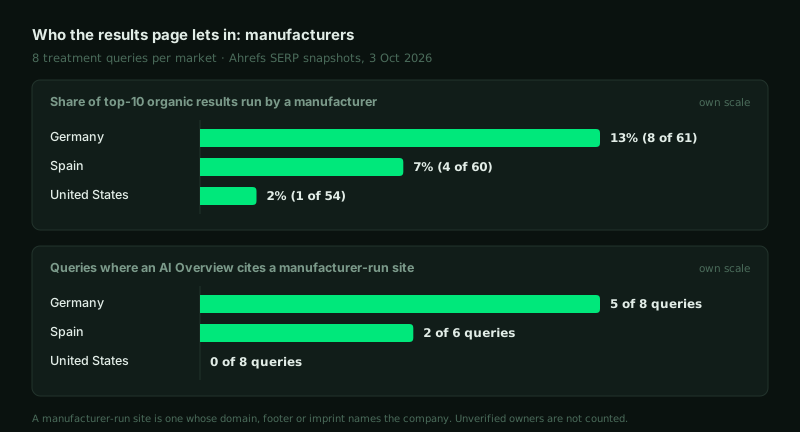
In Germany the eight results come from six different publishers:
| Site | Published by | Query | Position |
|---|---|---|---|
asthma.de | Novartis Pharma GmbH | asthma behandlung | 4 |
leben-und-migraene.de | Novartis Pharma GmbH | migräne behandlung | 6 |
wegweiser-neurodermitis.de | Pfizer Pharma GmbH | neurodermitis behandlung | 6 |
bepanthen.de | the Bepanthen brand | heuschnupfen behandlung | 7 |
psoriasis-initiative-ich.de | Bristol-Myers Squibb GmbH & Co. KGaA | schuppenflechte behandlung | 8 |
abbvie-care.de | AbbVie (in the domain) | migräne behandlung | 8 |
neurodermitis.de | Almirall Hermal GmbH | neurodermitis behandlung | 9 |
abbvie-care.de | AbbVie (in the domain) | neurodermitis behandlung | 10 |
Five of those eight results sit on domains that name neither the company nor a product. I found the publisher in the footer or imprint, which is what Article 86(2) produces: a resource about the disease, with the company behind it in small print.
Spain follows the same pattern more mildly, with four results: Almirall’s own site for psoriasis (no. 4), its neurology blog for migraine (no. 9), the professional site of Abbott’s FreeStyle glucose-monitoring brand for diabetes (no. 9) and Cinfa’s health portal for rhinitis (no. 9). The MSD Manuals, a reference publication of Merck & Co. that states its editorial independence, hold three more Spanish slots and are counted separately. In the United States there is one: Dupixent’s own site at no. 9 for “asthma treatment”.
What AI Overviews do with them
An AI Overview appeared for all eight American queries, all eight German ones and six of the eight Spanish ones. A manufacturer-run site was among the sources in five of the eight German overviews (psoriasis, migraine, eczema, asthma and hay fever), in two of the six Spanish ones and in none of the eight American ones. In the United States, Mayo Clinic or Cleveland Clinic was a source for all eight.
Eight queries per market is a small sample, so read it as a direction, not a rate. The direction is clear enough to act on: in markets where brands cannot promote the product, the disease site is eligible to be cited; in the United States, the institutions have the answer to themselves.
What pharma and medtech sites let AI crawlers do
I repeated the robots.txt survey on 94 healthcare sites on 3 October 2026, with the same engine and the same 28 crawlers.
| Group | Sites | Readable | Block a training crawler | Block an AI search crawler |
|---|---|---|---|---|
| Pharma | 32 | 26 | 0 | 0 |
| Medtech | 21 | 17 | 0 | 0 |
| Health publishers and reference | 25 | 23 | 14 | 10 |
| Public bodies and hospitals | 16 | 7 | 1 | 0 |
| General brand sample (21 September) | 230 | 168 | 33 | 23 |
- None of the 43 readable pharma and medtech files blocks any AI crawler, and 39 of them do not mention one. Pharma is not locked down against AI; it has simply not decided.
- The publishers do block. Drugs.com, Medscape, UpToDate, The Lancet and NEJM block PerplexityBot. Ärzteblatt and Everyday Health block OpenAI’s search crawler. Healthline, WebMD and Medical News Today block training crawlers but not OpenAI’s search crawler, so they can still be cited in ChatGPT search.
- The totals hide this. Across all 73 readable files, 20.5% block a training crawler, against 19.6% in the general sample — the same figure from a very different mix.
- Some files could not be read. Pfizer, Bayer and Teva answered my request with a 403, AstraZeneca’s and AbbVie’s connections failed, and ResMed and Coloplast also refused. My request carried a generic identified user agent, so this does not prove an AI crawler would be refused; it shows a firewall can sit in front of a permissive robots.txt.
- Almost nobody publishes an llms.txt. Six of 94, against 25.7% of the general sample; Takeda, Almirall and Biogen are the pharma companies among them.
What to do
Map every product against every market first
Prescription, over-the-counter or device, and what each market lets you publish to patients, signed off by regulatory affairs. This comes before any keyword research.
Decide which asset carries search in each market
Where public advertising of the product is allowed, a product site can. Where it is not, disease information is the asset, and it needs its own keyword research in the local language, because Germans and Spaniards do not search the way translations suggest.
Do not force hreflang between pages that are not equivalents
A product page for the US and a disease page for Germany are different pages. hreflang connects versions of the same page; pairs that do not exist should stay unpaired.
Decide what stays open
Content behind a professional login cannot be crawled or cited. That is a legal and an SEO decision, and it should be made together.
Test access the way a crawler arrives
Check what robots.txt says for the AI search crawlers with the robots.txt tester, then ask whoever runs the firewall what it does with them.
Measure per market
Whether an AI Overview appears for your queries and which sources it cites: the method above takes an afternoon, and the local SERP checker shows each market as its searchers see it.
Medical device marketing has its own rules in each market, which I did not research here. The 21 device makers in the survey behave like the pharma companies: none of the 17 readable files blocks an AI crawler. For the wider picture, healthcare SEO strategy for brands covers who holds the results page, and healthcare SEO across countries covers claims, medical review and E-E-A-T.
Sources
- European Parliament and Council, Directive 2001/83/EC, Articles 86 and 88, read in the text published on EUR-Lex on 3 October 2026. The Directive has been amended since; check the consolidated version before relying on it.
- Germany, § 10 Heilmittelwerbegesetz.
- US Code of Federal Regulations, 21 CFR 202.1, prescription-drug advertisements.
- MSD Manuals, Overview of the MSD Manuals: publisher and editorial independence.
- Ahrefs SERP overview, 3 October 2026: top-10 organic results and AI Overview sources for 24 queries (8 conditions in 3 markets). Ownership taken from each site’s domain, footer or imprint, including those of
asthma.de,leben-und-migraene.de,psoriasis-initiative-ich.de,wegweiser-neurodermitis.deandneurodermitis.de. /robots.txtand/llms.txtof 94 pharma, medtech, publisher and public-body sites, requested once each on 3 October 2026 with this site’s robots.txt fetcher: 73 readable files.